"Loveland": Suki Waterhouse album review

Updated: Aug 17
I love Suki Waterhouse the same way I love a good metaphor; I love her lacy lyrics, blurry voice, and the liquid state of her energy. In other words, she executes things in ways they can’t physically be executed. She’s there for the vibes, hence no matter what a song is about, it’s almost guaranteed to completely electrify the moment.
Loveland opens with total Old Hollywood flamboyance. The marching band sound opening on “Back in Love” is an incredible way to foreshadow the rest of the record (besides, oh my God, talk about aura). Perhaps the Old Hollywood theme doesn’t exactly summarize the record, but it sets a great precedent. Waterhouse is aggressive, lonely, out-of-her-mind in love, (slightly) chill, and nostalgic, much like the “emotional woman” archetype of the 20th century.

My favorite songs of Waterhouse’s are the aggressive ones, from the angry dance-pop “Oh My God” to the seductive “The Bellboy (One Last Crush)”, both from Memoir of a Sparklemuffin (2024). On Loveland, the sparkly “Any Man” shows Waterhouse in any girl’s element, “I can make any man fall, it’s a criminal kind of mind control, so funny when they go crazy”. “Tiny Raisin” – a title referencing bathtub-rotting – is ecstatic. I’d normally describe its topic as one “embracing the trials and tribulations of love” (cliché of a description on my behalf), but “embrace” is an understatement. She sing-yells, “That’s my man, hot damn, we gonna break up, make up, do it all over again, fuck yeah”. She sounds like she’s drunk on a rollercoaster, a hit-or-miss move varying by listener. “Puppy Dog Eyes” is brutal, “You say you fucking love me, I tricked you, now you’re on your knees… Don’t give me those puppy dog eyes”. From a cynical standpoint, I think this song is mildly questionable and pointless in its cruel nature considering that Waterhouse makes it clear on this album that she’s happily engaged. Why are you reminiscing on being fed-up with your man-eater victim when you have a man? But then the incredible electric guitar solos make me lose any judgment.
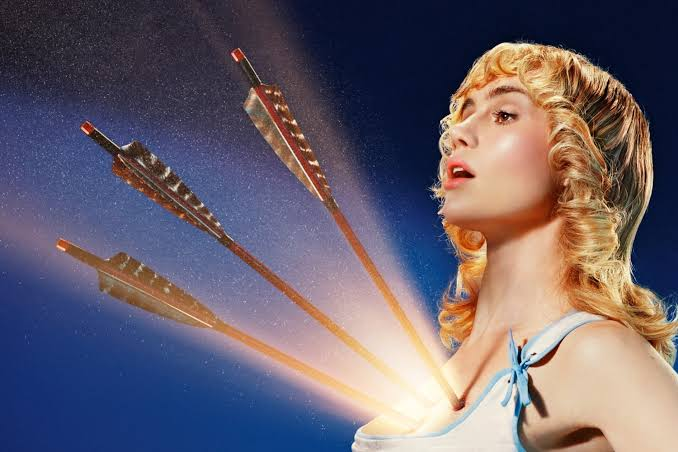
But still… Waterhouse’s statement about being in love is the first thing listeners hear when they hit play. “Back in Love” is floaty, “Happiness hits me when I’m back in love again/back to jazz on the radio, back to beaches, away we go”. It’s a lovely dancing-around-your-bedroom song. “Notting Hill” continues the fancy feeling of the opening track. Waterhouse basks in having her “picture in the morning papers”, and further laughs about her lover, “I bring you breakfast back to bed, you’re my favorite flavor/you light a cigarette instead, my God, you’re shameless”. She takes a pause from being in love for a chunk of the album, almost making me forget. The title track bringing the theme back is a weak effort. The song fades into the background. She saves it with the adorable slower closer, “Weirdo”: “Maybe next year, we’ll have a staycation, morning routines and make reservations/baby, till then, I’m letting you know/I’m missing my favorite weirdo”.

Despite adoring her fiancé, Waterhouse, as we’ve established, doesn’t forget prior experiences with other men. I shift a little on my prior statement on “Puppy Dog Eyes” – I can see how it’s fitting for an album titled “Loveland” to show all the sides of such a place: the independently empowered, the in-love, and the in-club. For the in-club, she details the exhausting rhythm of an on-and-off relationship in “Teardrops”, pulling from the same double-entendre as “Tears” by Sabrina Carpenter. I prefer Waterhouse’s execution; Carpenter leans completely on the sexual innuendo, using the title as a red herring, but Waterhouse makes use of both the sexual and sad interpretations of a tear. This sadness gets even more dire in the following self-explanatory ominous track, “When I Get Drunk (I Want You Boy)”. Immediately following these sad-but-upbeat songs, Waterhouse re-enters her element in the banger “Jukebox”, “I know I’m a cutie, yes, I can be moody, but I’m absolutely taking your call”. It’s like a first part to the story of “Puppy Dog Eyes”, but less questionable and just as fun. Last is the most devastating of the in-club bunch: “Almost”. It’s impressive that Waterhouse can make inappropriate lyrics feel so profound:
I almost rode you there in the backseat
My heart was beating, you could’ve had me
Yeah, I know that you were thinking about it
It’s always gonna be a ‘What could have happened?'
Oh, God, the moment, it was so cinematic
I think the ending’s almost better without a kiss, almost

On that note, the one completely sad song, placed right smack-dab in the middle of the record, is the stunning “Seasons”. Waterhouse details struggling with learning to be alone, and hits on one of the things I begin to fear each time I feel impending seasonal depression, “How sad that the seasons change, but the loneliness stays”.
As we continue into the dead of summer, I hope we can observe Waterhouse’s demeanor say goodbye in real-time to this never-ending sadness. I can assure you she’s great in concert – I saw her open for Laufey in October. You can purchase tickets to the Loveland Tour here. Loveland is available on all streaming services now.

Comments